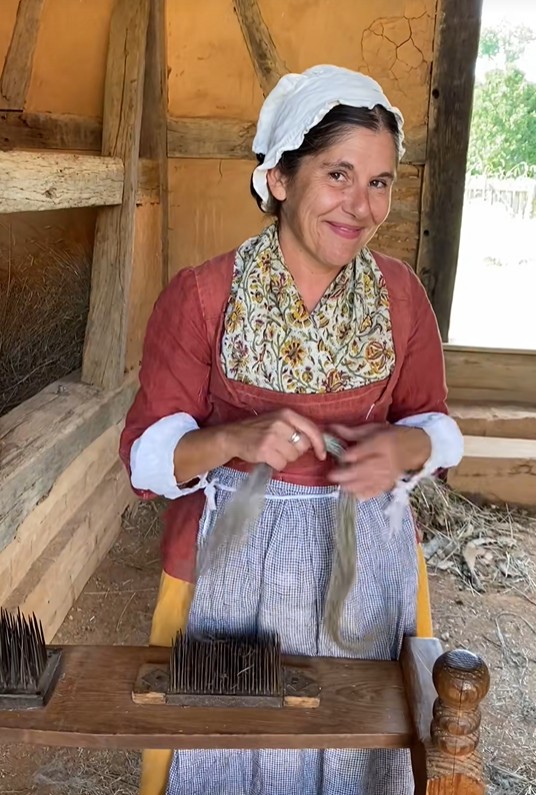
Misti Furr is a Living History Interpreter at the Frontier Culture Museum of Virginia, where she brings decades of experience, research, and dedication to helping visitors understand the past within a broader historical context. Waynesboro-based marketing firm Standout Arts spoke with Furr about her work, her commitment to accuracy in living history interpretation, and her passion for connecting historic events to the world we live in today.
A Staunton-area native, Furr has worked in museums and historic sites for twenty-eight years, with twenty-six of those years focused specifically on living history and interpretation. Her professional path was shaped early on by her time at Colonial Williamsburg, an experience she credits with drawing her deeply into the field.
Although she had long been interested in history, Furr’s entry into living history came through an unexpected route. Her husband became an apprentice blacksmith in Colonial Williamsburg’s trades department, which led the couple to spend fifteen years in the Tidewater region. During that time, Furr worked with Colonial Williamsburg, the National Park Service, Virginia State Parks, and Preservation Virginia, which manages multiple historic sites across the state, including the archaeological site on Jamestown Island.
In 2012, Furr joined the Frontier Culture Museum when her husband accepted the position of head blacksmith.
Today, Furr’s interpretive expertise allows her to work across every site at the museum, including the forge. Most of her time, however, is spent on the Native American site and the Eastern Woodland site. There, she leads a variety of projects, including traditional fire pottery. As she explained with characteristic humor, “I have a lot of projects I do there including making and firing pottery. I had no experience in that whatsoever before starting to do it. I always tell people, I'm not artistic, I'm just really stubborn.”
Another major responsibility is planting and maintaining the museum’s crops, a task that serves both educational and preservation purposes. Furr explained that these plantings allow visitors to understand not only how and why crops were grown historically, but also how those plants are preserved today. “We not only show people how and why they were being grown, but we also can use those for seed saving,” she said. Some of the corn varieties grown at the museum are rare and not commercially available. “They're ones that I've acquired through various means of trading with other sites or whatever else. And some of those are endangered. So, we're preserving a seedbank for the future.”
Commitment to Historical Accuracy
Like her fellow living history interpreters at the Frontier Culture Museum, Furr approaches her work with an unwavering commitment to historical accuracy. For her, that commitment involves both scholarship and collaboration. Over nearly three decades in the field, she has built an extensive professional network. “I have found in the last 28 years, that the history field within the museum field is really small,” she said. “I know museum educators and interpreters and curators and folks that are directors of museums, large and small throughout the country from a lot of the contacts that I have.”
Furr also emphasized the importance of asking the right questions of history. While historical study often follows a chronological structure, she noted that interpretation evolves based on perspective. “When you look at history in a broad range it's a chronological study of the past,” she explained, “but what changes are the questions we ask of history.” By examining history through lenses that were once overlooked, such as women’s roles or voices absent from traditional documentary records, new insights can emerge. Evidence, she noted, can often be found through archaeology, oral history, and careful examination of existing documents, as long as historians are willing to ask different questions.
Research plays a central role in Furr’s work. In addition to relying on respected journals and scholarly resources, she makes extensive use of digitized primary source documents. Many counties now provide online access to records dating back to the eighteenth century, and in some cases even the seventeenth century. Using a large screen in her office, Furr transcribes these documents herself, often uncovering details that had previously gone unnoticed.
A Unique Skill
One of Furr’s most valuable research tools is her ability to read eighteenth-century handwriting. She developed this skill during her time at Colonial Williamsburg, where she learned traditional penmanship using a quill pen. “One of my skills that I acquired when I was at Colonial Williamsburg was 18th century penmanship,” she explained. That knowledge allows her to accurately interpret historical documents by understanding how letters were formed at the time.
This expertise has led her to correct errors in previously transcribed records. “I've looked at previously transcribed documents and gone through and went, no, the word that they've written here is not the word that was used,” she said. While some corrections may be minor, others can have broader implications. “It might change history, or it might just make you feel better that it's the right word.”
Closing Thoughts
For Furr, living history is not simply about reenactment, but about education and understanding. She sees it as a way to help visitors place historical events within a broader global and social context. “One of the most important facets of Living History interpretation is that we can help visitors contextualize history,” she said. “That is, we can place historic events, or the past, within the greater context of what is going on in the world. This is important because history does not occur in a bubble!”
The Frontier Culture Museum of Virginia is the largest open-air living history museum in the Shenandoah Valley and one of the highest-rated family-friendly attractions in the state. Costumed interpreters demonstrate the daily life and traditions of Indigenous peoples of Virginia, the arrival of German, English, and Irish settlers along the Great Wagon Road, and the forced journey of enslaved Africans to the first permanent British colony in North America. Visitors can also engage with skilled tradespeople such as blacksmiths, woodworkers, tailors, and yarn spinners while learning how early settlers lived, worked, and built their communities.
For more information about the Frontier Culture Museum of Virginia, visit frontiermuseum.org.


%20(1).png)